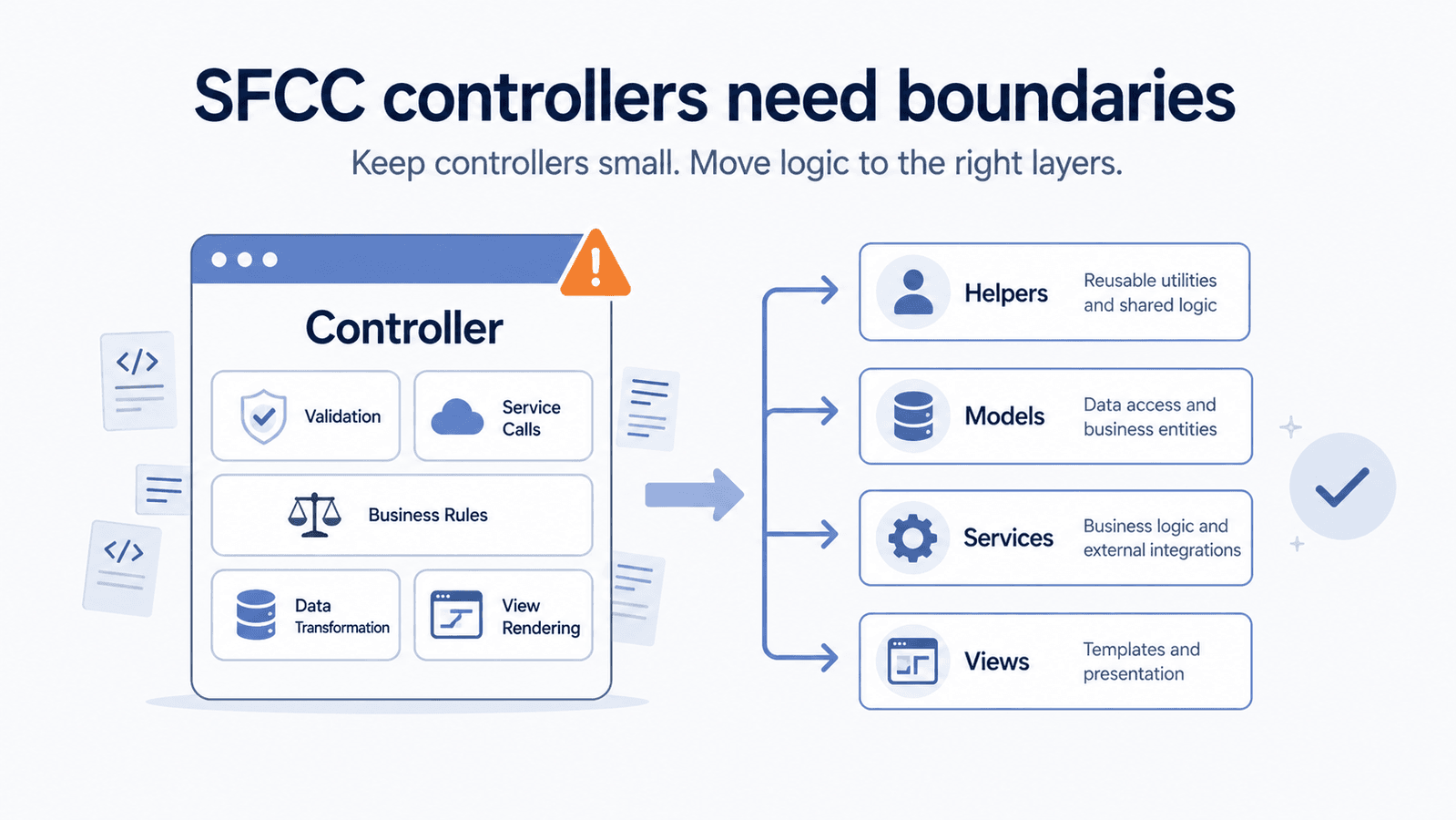
If your SFCC controller is doing everything, the problem is not JavaScript.
The problem is boundaries.
One thing I keep seeing in B2C Commerce projects is controllers that validate forms, call services, transform data, decide business rules, and prepare the view all in one place.
It works for a while.
Then a small change arrives.
Then another.
Then debugging becomes slow.
Then nobody wants to touch the code before a release.
SFRA gives teams a better path, but only if we use it with discipline.
A controller should orchestrate the request.
Not become the whole application.
When controllers stay small, teams can move business logic into helpers, models, scripts, or service layers where the code is easier to test, reuse, and reason about.
That is not just a clean code discussion.
It affects delivery speed, defect rate, and team confidence.
Many SFCC performance and maintenance problems do not start in infrastructure.
They start when the project turns the controller layer into a dumping ground.
If your team is learning SFRA or trying to clean up an existing storefront, this is one of the first habits worth fixing.
I cover this kind of practical SFRA work in more depth in Salesforce Commerce Cloud 201:
https://www.sfcclearning.com/course-detail/salesforce-commerce-cloud-201/18640/
What is the most common controller mistake you keep finding in SFCC projects?