An SFCC integration is not finished when the endpoint works.
That is only the first checkpoint.
In real B2C Commerce projects, integrations usually fail in the space between systems:
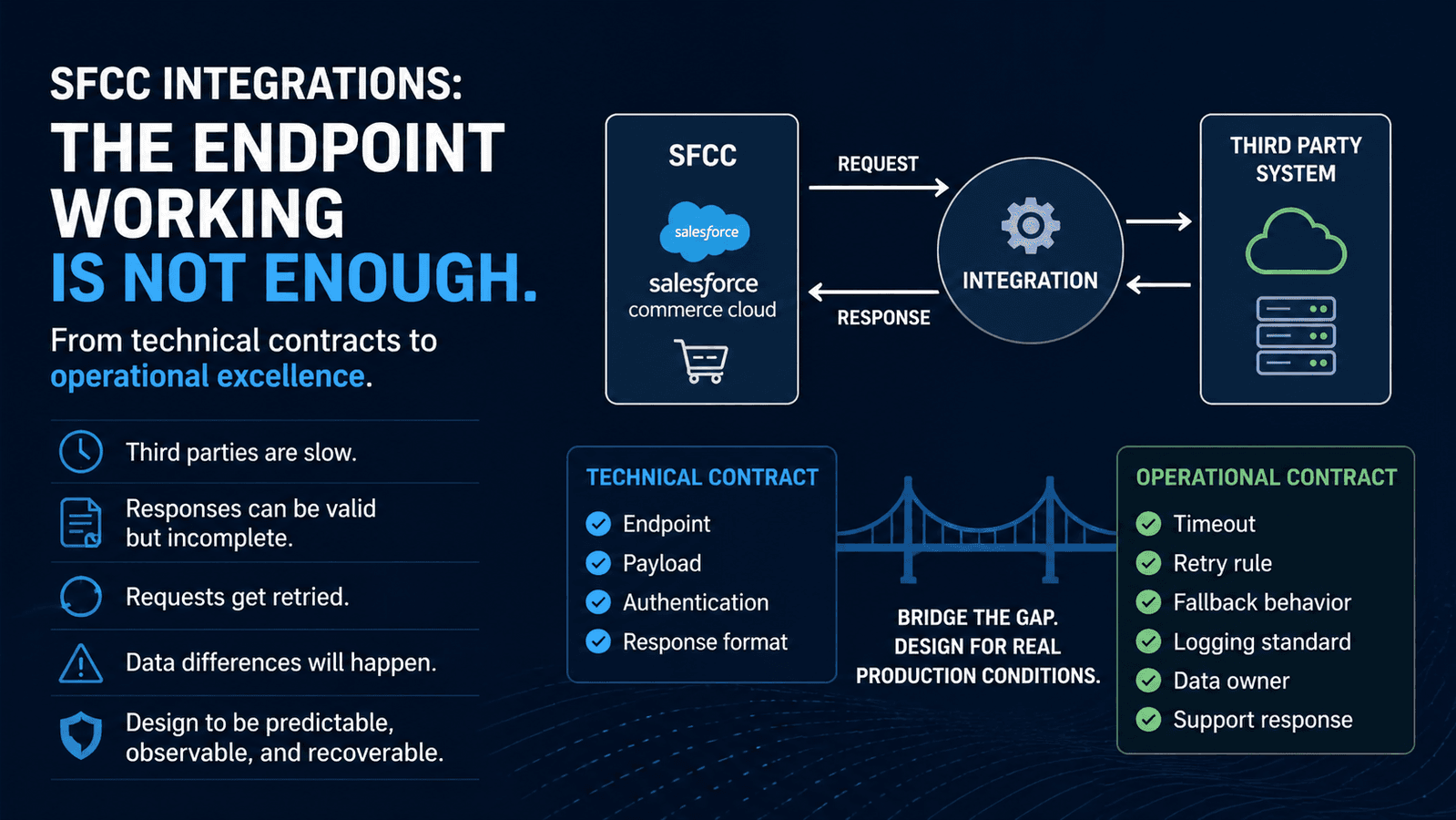
What happens when the third party is slow?
What happens when the response is valid, but incomplete?
What happens when the same request is retried?
What happens when the business asks why an order, price, customer, or inventory value is different?
Those are not edge cases.
They are normal production conditions.
This is why I prefer to design SFCC integrations around operational contracts, not only technical contracts.
A technical contract says:
Here is the endpoint.
Here is the payload.
Here is the authentication.
Here is the response format.
An operational contract adds:
Here is the timeout.
Here is the retry rule.
Here is the fallback behavior.
Here is the logging standard.
Here is the owner of the data.
Here is what support should do when it fails.
That second part is where many projects save or lose hours.
The storefront code can be clean.
The OCAPI or service configuration can be correct.
The integration can still be weak if nobody knows how it behaves under pressure.
Good integration design in SFCC is not about calling more APIs.
It is about making the data flow predictable, observable, and recoverable.
Before I approve an integration design, I want the team to explain the unhappy path with the same clarity as the happy path.
Because production will test both.
If your team is working with OCAPI, hooks, authentication flows, Postman collections, or custom integration patterns in B2C Commerce, I cover those topics in:
OCAPI for Salesforce B2C Commerce
https://www.sfcclearning.com/course-detail/ocapi-salesforce-b2c-commerce-sfcc/18937/
What is the integration failure mode your team designs for first in SFCC projects?