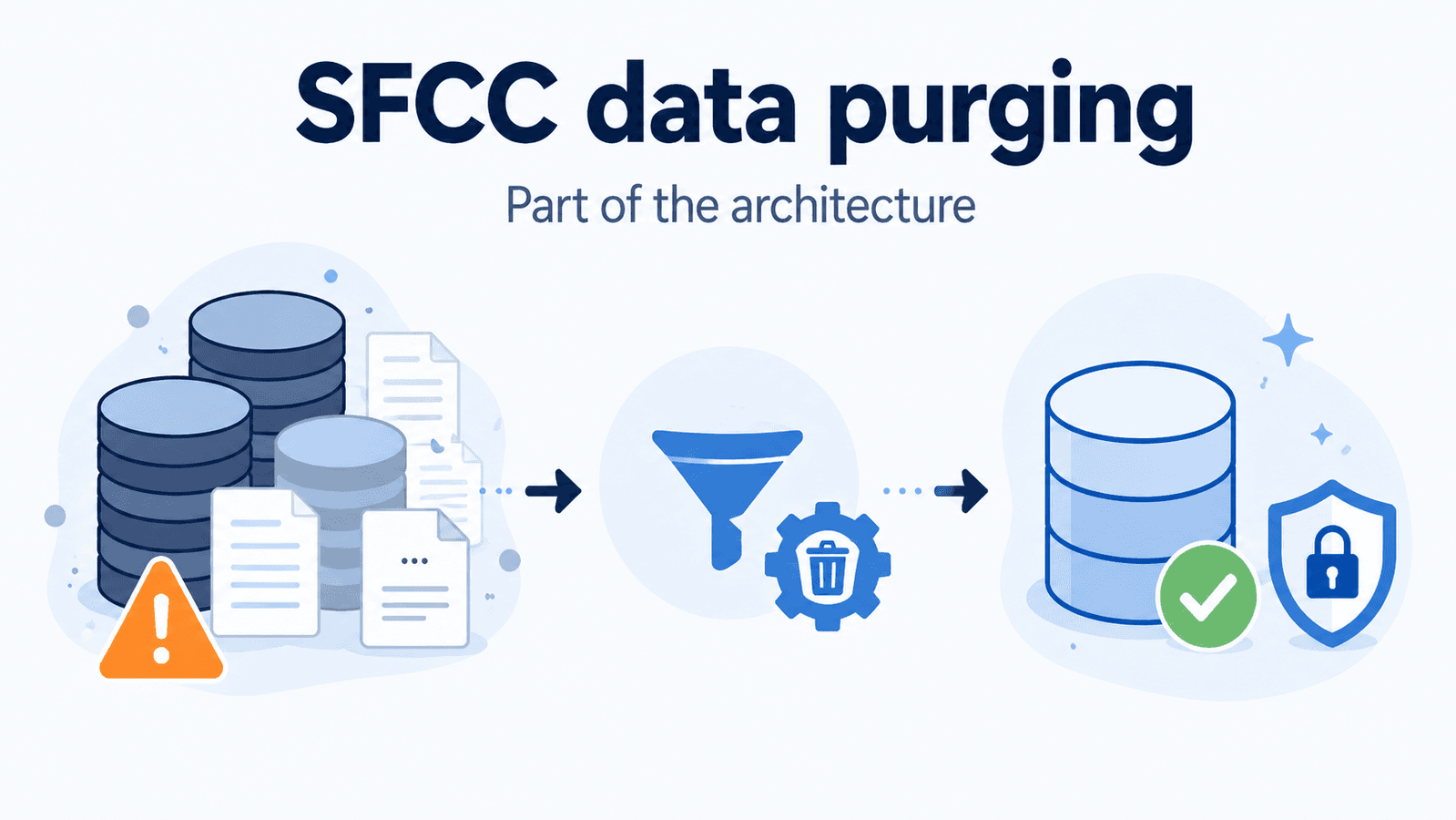
Data purging in SFCC is not housekeeping.
It is part of the architecture.
Many teams only talk about old data when something becomes slow, heavy, or uncomfortable:
The job takes too long.
The export is too large.
The custom object table keeps growing.
The logs are noisy.
The team is afraid to delete anything because nobody remembers who uses it.
That last sentence is the real problem.
Data without ownership becomes risk.
In B2C Commerce projects, retention rules should not be decided after go-live by the person who happens to find the storage problem first.
They should be part of the design.
Before creating another custom object, another import file, another audit record, or another operational log, the team should be able to answer:
Why do we store this data?
Who owns it?
How long do we need it?
What depends on it?
How can we delete it safely?
What evidence do we need before and after the purge?
Purging is not just about saving space.
It affects performance, privacy, troubleshooting, integrations, and support.
A good purge process is predictable.
It runs in controlled batches.
It has clear filters.
It logs what it changed.
It can be tested in lower environments.
It does not surprise the business on a Monday morning.
The weak version is a script nobody wants to touch.
The strong version is an operational rule the whole team understands.
This is one of those SFCC topics that looks small until it becomes expensive.
Design the data lifecycle before production teaches it for you.
What type of data do you see teams keep for too long in SFCC projects?
Architecture
Data purging in SFCC is not housekeeping. It is architecture.
2 minute read