An SFCC performance test that only proves the homepage can survive traffic is not enough.
It may be technically true.
It may also be commercially useless.
Real B2C Commerce traffic is not a single page with clean cache and polite users.
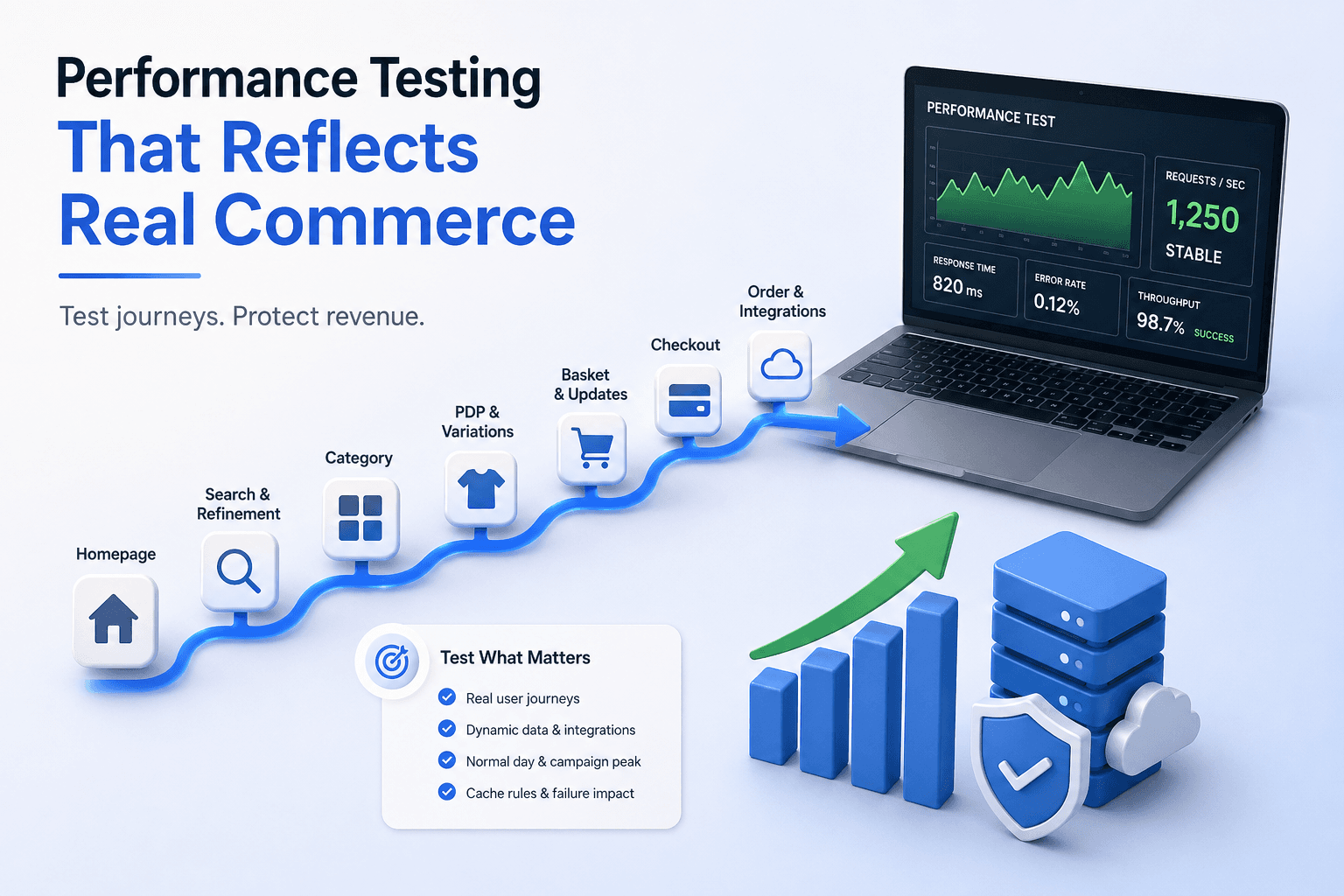
It is product search.
It is category navigation.
It is PDPs with variations.
It is promotions.
It is inventory checks.
It is basket updates.
It is checkout.
It is third-party calls.
It is business users asking why the site is slow during the exact campaign the team said was ready.
This is why performance testing in SFCC should start with scenarios, not only numbers.
Before looking at requests per second, I want the team to define:
Which journeys matter most?
Which pages depend on dynamic data?
Which integrations are on the critical path?
Which traffic mix represents a normal day?
Which traffic mix represents a campaign peak?
Which cache rules are expected to protect the storefront?
Which failure would hurt revenue fastest?
Those questions change the test.
A site can pass a synthetic load test and still fail under real merchandising behavior.
A search page with heavy refinements is not the same as a cached content page.
A PDP with complex variation logic is not the same as a static landing page.
A checkout step waiting for payment, tax, fraud, or inventory services is not the same as browsing.
Performance is not only infrastructure capacity.
It is the result of architecture, data quality, cache design, integration behavior, frontend weight, job timing, and release discipline.
The strongest SFCC teams do not treat performance testing as a late checkbox.
They use it to validate assumptions before launch pressure removes the time to think.
The goal is not to create a beautiful report.
The goal is to find the uncomfortable truth early enough to fix it.
What SFCC journey do you always include in a serious performance test?
SFCC Performance
Your SFCC Load Test Passed… But Would Your Checkout Survive a Campaign Peak?
2 minute read