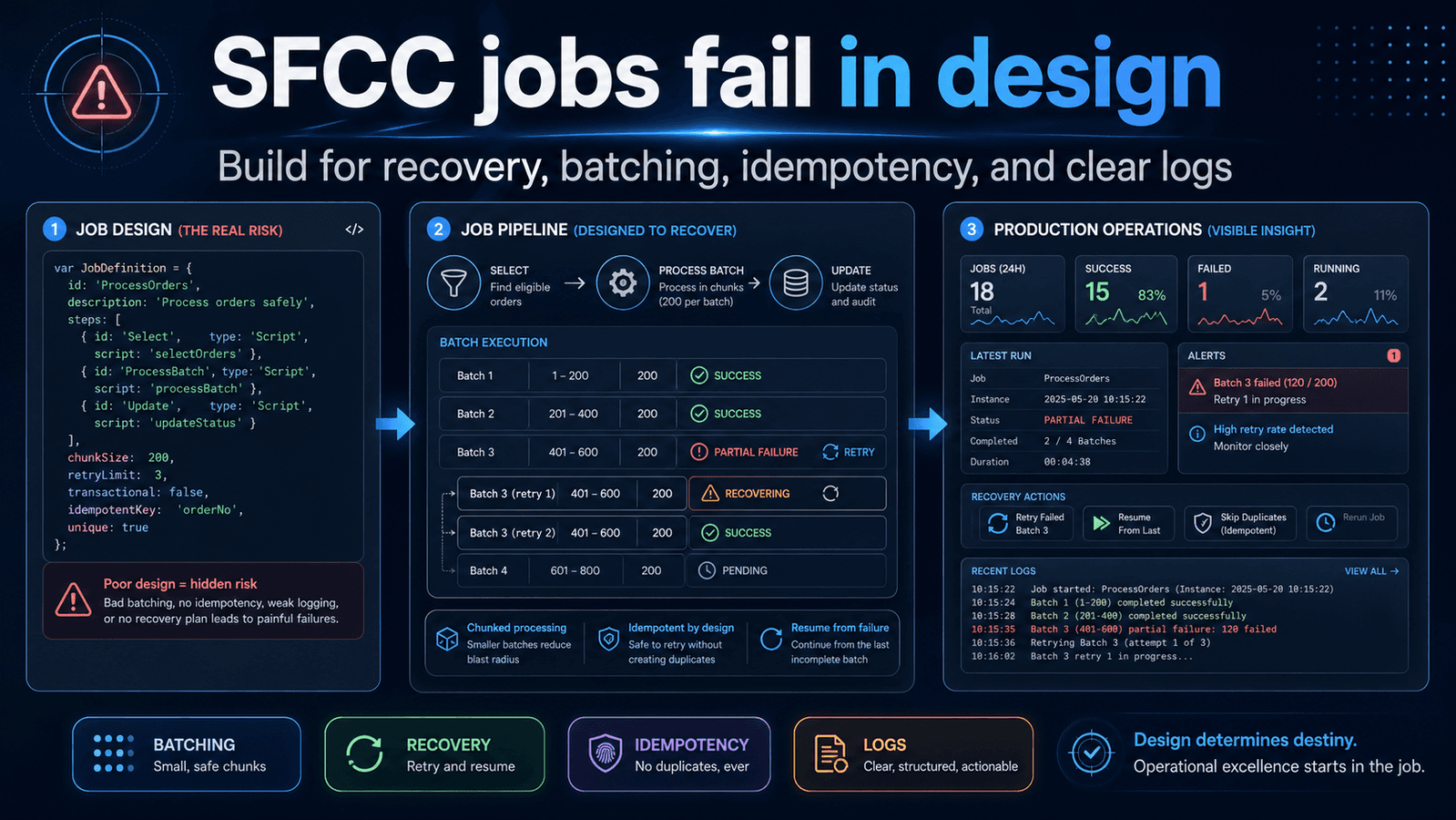
Many SFCC jobs fail long before they throw an error.
They fail in the design.
A job that works with 50 records in a sandbox is not ready for production just because the happy path is green.
Production will ask harder questions:
Can it resume after a partial failure?
Can it process data in safe chunks?
Can it explain what happened in the logs?
Can support rerun it without creating duplicates?
Can the team understand the business impact without reading the whole script?
This is where many B2C Commerce implementations get fragile.
The job is written as a script.
But it should be designed as an operational process.
That means clear input rules, predictable batching, idempotent behavior, useful counters, meaningful error handling, and logs that help someone make a decision at 2 AM.
The code matters.
The recovery model matters more.
I have seen teams spend hours debugging a "random" production issue that was not random at all.
The job processed too much at once.
The error message did not include the record context.
The retry created duplicate work.
The status said failed, but nobody knew how far it got.
None of that is a Salesforce limitation.
It is an implementation habit.
For SFCC teams, a good job is not only one that finishes.
A good job is one that can fail clearly, recover safely, and leave enough evidence for the next person.
That is the difference between automation and operational debt.
What is one job design rule your team never skips in SFCC projects?